
Missing berries at your local farmer’s markets? Blame the weather
By Amelia Wysong/Kent State NewsLab
Orchards in Ohio faced difficulties with fruit crops this year due to unusual weather conditions in March and April.
In mid-latitude places like Ohio, growers this year experienced a false spring — an unusually warm late winter, said climatologist and Kent State University professor Scott Sheridan. These conditions damaged fruit crops like strawberries, cherries and peaches.
“And what that does is it has a tendency to trick a lot of plants into coming back to life for spring, starting to bud, and so on, but then when you get a return to either normal weather or below normal weather, you then have frosts,” Sheridan explained. “And if you have frost damage to a bloom, especially on a fruit tree, typically then you’ve lost the fruit for the year.”
Frost damage happens often, but this year was worse for parts of northern Ohio. “In this case, it was really extreme because we had such anomalously warm weather for much of March and April and then anomalously cold in May that led us to the situation here in northeastern Ohio,” he said.
Quarry Hill Orchards in Berlin Heights experienced damage to stone fruit buds due to freezing overnight temperatures in April. In Salem, Huffman Fruit Farm only got about half or less of their usual spring crops.
Miles Market in Solon typically buys stone fruit like peaches and nectarines from growers in Ohio. This year, these fruits from Ohio growers have been almost non-existent, said Justin Golobek, general manager of Miles Farmers Market in Solon The impact of the weather was greater for growers in northern Ohio specifically.
“It seems to be most of our northern connections,” he said. “We have a group of farmers kind of out more towards Sandusky, and then we have some more kind of out towards Perry and Madison out that way, and they both seem to get hit pretty good. My southern [Ohio] growers have some stuff, but not a ton.”
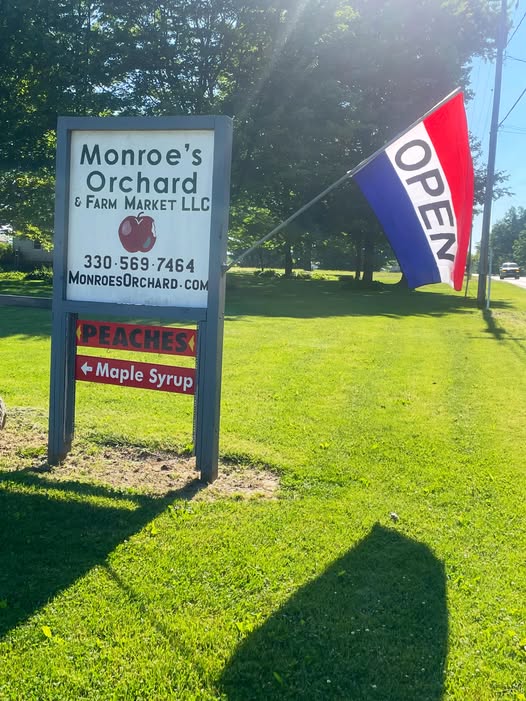
Fourth-generation family business Monroe’s Orchard in Hiram experienced issues with a variety of fruits including cherries, strawberries and peaches this year. Sisters Allison Monroe and Angela Gingerich took over the orchard from their parents in December.
“It’s a little depressing this year, but with farming you have years like that,” Gingerich said. “And I’m hoping that this is my one bad year and I’ll compare all the other years to this one, and we won’t repeat this again, hopefully.”
Normally, Monroe’s has strawberries followed by sweet and tart cherries in June going into July, Gingerich explained. The frost wiped out both the sweet and tart cherries completely. The strawberry plants – already weakened by conditions last year – were not healthy enough to withstand the false spring and produce a good crop this year.
In a typical year, Monroe’s Orchards offers pick-your-own strawberries, which brings in a lot of customers. “We generally, in strawberry season, we’ll open at 8 o’clock and we have customers lined out the drive trying to get in early, and then we stay open as long as we have berries on the field.” she said. “So on a real busy Saturday, if we have a good crop, sometimes we’re closing two hours after we open because we just have hundreds of cars here.”
While Monroe’s is still offering fruits bought from other growers at their market, customers that want the pick-your-own experience are not coming out this year which has affected the business, Gingerich said. The orchard does not have a customer-base for fruits grown elsewhere yet.
Loyal customers have been supportive both online and in-person, Gingerich said. “Despite us having a hard year, I have a lot of customers coming in and they’re sharing their favorite memories of coming here because they’ve been coming here for years,” she said. “So that’s been a silver lining, it just makes you feel [like] people are loving on us in that way, which is really nice.”
As the summer progresses, Gingerich is hopeful about the apple crop and business in the fall. Monroe’s expects they will have enough apples to offer a pick your own experience, and they are anticipating a busier fall season, she said.
“We will have some apples and they’re looking pretty good,” she said. “[I’m] looking forward to late August, early September when we can start, you know, selling some of that stuff.”
This story was written by Amelia Wysong for Kent State NewsLab, which shares stories by Kent State University School of Media and Journalism students with professional media partners. This story was produced in association with Media in the Public Interest and funded in part by the George Gund Foundation.
Photo caption and credit: Monroe’s Orchard is open despite fewer berries this year. Photograph courtesy of Allison Monroe.