
State lawmakers propose guardrails to limit the sharing of license plate camera data
By The Statehouse Reporting Project
Widespread networks of automated license plate surveillance cameras that create hordes of data used to track motorists are under increasing scrutiny by lawmakers and privacy advocates in the wake of their recent use by Immigration and Customs Enforcement.
Lawmakers in 35 states have proposed nearly 100 pieces of legislation this year regarding license-plate readers – many seeking to prohibit states from sharing or selling years’ worth of data that could be used to extensively track drivers, according to BillTrack50, a legislative tracking service.
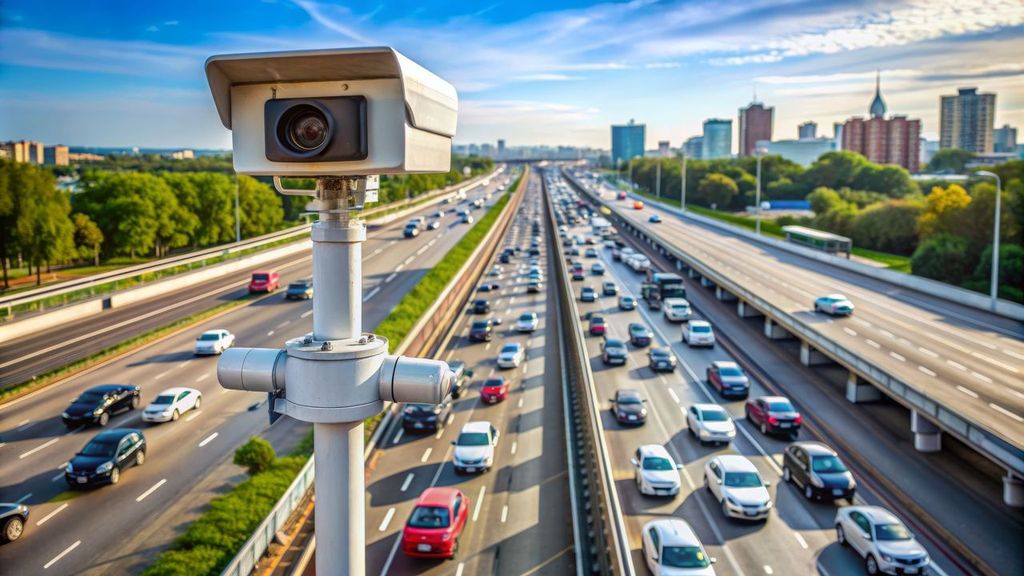
These scanners and cameras can be found on roadsides, traffic lights and on police cars. In addition to tracking vehicles, they can pick up details, from scratches to speeding, through data sharing of long-term stored surveillance.
Critics of the system say they can be used not just for immigration enforcement, but also for tracking people who cross state lines for abortions or gender-affirming care.
But Dillon Reisman, an attorney with the American Civil Liberties Union in New Jersey, said everyone, not just members of vulnerable communities, should be worried about the issue.
He said data from license plate readers can help ICE and other agencies create a detailed picture of someone’s life: where they work, where they worship, what healthcare they receive and where they socialize. The information is stored for three years in New Jersey.
“Retaining it for a longer period of time only increases the intrusion on someone’s privacy,” Reisman said.
“When that data is shared with ICE, it gives ICE and other federal authorities the power to search through license plate reader data for up to three years and learn someone’s patterns, history and whereabouts,” he said.
But advocates for the automated license plate recognition (ALPR) systems say they are powerful tools to assist law enforcement and make communities safer.
“ALPR is a double-edged sword that has helped catch some very bad people,” said Indiana state Sen. Blake Doriot, a Goshen Republican.
He voted for House Bill 1150, banning homeowners’ associations from installing the plate readers, which was signed into law by Indiana Gov. Mike Braun in February.
“Anywhere there’s data, there’s a price because people want that information,” said Doriot. “Is it our right to drive down a public road and be anonymous? I think it is, so I’m not 100% a fan of it because it can be abused, and has been abused, and there are no real repercussions on the people who use it wrong.”
In Connecticut, lawmakers have proposed a bill that restricts how long license plate data can be stored by law enforcement or any public agency for the purpose of investigating an individual based on race, ethnicity, pregnancy status or gender identity.
State Rep. Fred Gee, a Bridgeport Democrat and one of the co-sponsors, said the goal was to provide transparency and accountability of automated license plate reader uses.
“Residents deserve confidence that their data won’t be used to target them based on protected characteristics, their lawful activities, or sensitive health-related decisions,” he said in an email. “These protections help build trust between communities and those who serve them.”
New Jersey Sen. Linda Greenstein, a Plainsboro Democrat, proposed bill S1290, which prohibits sharing data collected by license plate readers with out-of-state law enforcement officers investigating travelers seeking reproductive healthcare services that are legal in New Jersey.
“I think it’s important for us to do it, because in our state, reproductive techniques or procedures are legal, and we don’t want to facilitate the work of these other states where it isn’t legal,” she said. “We need to defend our laws and make sure things are done our way.”
New Jersey Assemblyman Brian Bergen, a Denville Republican, believes the systems can help law enforcement, but condemns collected data being stored for prolonged periods and used for unauthorized searches by law enforcement.
“I do not want a Big Brother government profiling where Brian Bergen drives around the city at times. That is overly intrusive,” he said. “To store it and maintain it and track it and put it in databases, that’s just ridiculous. That’s too much.”
Flock Safety, the nation’s largest AI-public safety technology company, is working to form a vast network across states and entering into contracts with law enforcement agencies and private organizations. Flock has more than 80,000 cameras in 49 states, according to the Center for Human Rights at the University of Washington.
Georgia is a hot spot for these cameras, with over 5,000 across the state, according to DeFlock, a crowdsourcing mapping project put together by opponents of the surveillance systems. This makes Georgia among the states with the highest density of the company’s surveillance units.
“We have seen results as far as crime decreasing, being able to make more arrests and find out who’s doing certain crimes,” said Capt. Decorian Almond, who is Barrow County’s criminal investigation commander.
Barrow County has about 70 Flock cameras in use, helping assist the unit.
Felix Bell, a member of the Athens-Clarke County Public Civilian Safety Oversight Board in Georgia, said law enforcement is not transparent about the technology’s use and that should concern the public.
“When I asked, as part of the board, to see what data they are collecting, not only will they not tell me, they don’t legally have to,” he said.
Georgia law enforcement officials like Almond say the information the cameras collect is not public data and cannot be obtained through open records requests asking for specific vehicles. However, some members of the public fear that private entities with Flock subscriptions could access this data.
“They have no control over the Flock cameras, they have no control over the video feed, they have no control over where that video feed goes,” said Bell.
In Indiana, 2,442 license plate readers have been found by DeFlock. Law enforcement will not disclose how many readers there are in the state.
Eyes Off Indiana, a non-partisan, nonprofit organization that works to establish clear statewide limits on license plate readers’ use, said there are no state regulations on these devices. The data collected is not public record, and governments can share, sell or hold onto this data and use it in whatever way for as long as they would like.
“The data is absolutely being shared,” said Walker Lasbury, executive director of Eyes Off Indiana. “And when I say shared, I’m not just talking about other agencies in Indiana. These agencies are working with federal partners as well, and there is no limitation to how that must go.”
In Kansas, a bill could limit law enforcement’s use of traffic cameras. An amendment to Senate Bill 478 would restrict law enforcement from installing cameras and other automated license plate readers on utility poles and other structures. The only exceptions are if police issue a warrant or if the pole is in a public area zoned for commercial activity or recreation.
State Sen. Kenny Titus, a Flint Hills Republican, proposed the amendment. He said the data from automatic traffic cameras would be public record and subject to the Kansas Open Records Act.
Titus also said governments do not require a subpoena to access the data, but if it’s protected from disclosure, it could be requested in court proceedings.
Data from license plate readers can be shared among local jurisdictions, and practices would differ from town to town, he said.
Data storage would also be controlled by local policy, according to Titus. He said there is no uniform law across Kansas on time limits for data storage and what happens to it after.
Titus said police are mostly opposed to the bill, arguing it limits their surveillance capabilities and hinders their response to criminal activity. Meanwhile, activists have generally supported limitations to preserve constitutional liberties and prevent the establishment of a government surveillance state.
Senate Bill 478 was introduced following a controversy last year in Lenexa, Kansas. Reports surfaced that police allegedly used the plate readers to track a resident who had written a critical article about the Lenexa Police Department.

In Ohio, HB 725 would make it a crime for anyone to sell, transfer or share data from license plate readers for commercial use.
State Rep. Kevin Miller, a Republican, introduced the measure after several instances of data misuse were documented in Ohio, particularly in domestic violence cases.
“For me, I see this bill as something proactive where we address the situation before something takes place,” he said.
The ACLU of Ohio is an advocate for license plate data regulation.
“Police have a job to do and we respect that, but there is no good reason to store license plate data tracking the movements of innocent people in a government database,” Melissa Bilancini, policy coordinator for the ACLU of Ohio, said in a statement.
In New Jersey, the ACLU’s Reisman said, “Until there is comprehensive legislation and comprehensive policies on our reining in the sort of reckless use of surveillance technology, like ALPRs, on a statewide basis … I don’t think any New Jerseyan should rest easy that these systems exist.”
This article was produced through the Statehouse Reporting Project, a collaborative effort by collegiate journalism programs across the country. The lead reporter was Brinda Patel of the College of New Jersey and contributors were Gavin Foster, the University of Connecticut; Luke Shepherd, Franklin College; Sonja Sutcavage and Andrew Otten. the University of Georgia; Jack Bordeleau, the University of Kansas; and Kayla Gleason, Kent State University.